

Why Artisan Candles Cost More: What You Pay For
Last Updated: 23 October 2026
Quick Summary
Artisan candles cost more because the price reflects better wax, a fuller fragrance load, a properly matched wick and hand-pouring in small batches rather than machine production. Every decision in an artisan candle is made to burn well and smell properly, while mass-market candles are built to keep unit cost low.
- Vegetable waxes generally cost more per kilogram than paraffin and demand more attention during pouring.
- Fragrance oil is one of the most expensive ingredients, and a generous load uses noticeably more per unit.
- Small batches mean more testing, more rejected pours and far higher labour per candle.
- Most well-made scented candles last between 40 and 60 hours of burn time.
- Divide price by burn hours to compare cost per hour of good scent, not cost per jar.
Table of Contents
- Why Artisan Candles Cost More: The Short Answer
- Artisan Candles vs Supermarket Candles: Where the Money Goes
- What Makes a Candle High Quality: Wax, Wick and Fragrance Load
- The Hidden Costs of Hand-Pouring in Small Batches
- How Long Do Scented Candles Last, and Does Price Change That?
- Are Handmade Candles Worth It? A Practical Way to Decide
- Conclusion
- Frequently Asked Questions
Why Artisan Candles Cost More: The Short Answer
Artisan candles cost more because the price reflects what goes into them, not just what they smell like. At Absolute Whifs, we make every candle by hand in small batches, and that changes the maths completely: better wax, a fuller fragrance load, a proper wick, and a person standing over a melter rather than a machine stamping out thousands an hour. A supermarket candle can be cheap because every decision is made to reduce unit cost. An artisan candle is made to burn well and smell properly, and those two goals pull in different directions.
Below, we break down exactly where your money goes, why hand-pouring carries hidden costs, and how to decide whether the premium is worth it for you. But first, here's what most price comparisons get wrong: they compare jars, not what's inside them.
Artisan Candles vs Supermarket Candles: Where the Money Goes
The biggest difference between artisan candles and supermarket candles isn't the label, it's the recipe. Mass-market candles are built around paraffin wax and a modest amount of fragrance, because both keep the unit cost low and the shelf life predictable. Artisan makers tend to work with vegetable waxes and dose them far more generously with scent.
That single decision cascades through everything else:
- Wax: Vegetable waxes generally cost more per kilogram than paraffin and behave differently in the pot, so they demand more attention during pouring.
- Fragrance: A candle that actually fills a room needs a serious fragrance load. Skimping is the easiest way to cut cost, and the first thing you notice when you burn a cheap candle.
- Wick: A wick matched to the wax and the jar diameter burns cleanly. A generic wick is cheaper and often tunnels or smokes.
- Container and finish: Decorative tins, colour and toppings all add cost that a plain glass votive avoids.
None of this is marketing fluff. It's the difference between a candle that scents a room for an evening and one you forget is lit.
What Makes a Candle High Quality: Wax, Wick and Fragrance Load
A high-quality candle is one where the wax, wick and fragrance are chosen to work together, so the candle burns evenly and throws scent consistently from first light to last. Get any one of those three wrong and the others can't compensate.
Wax sets the baseline. Vegetable waxes burn cleanly and hold colour well, which is why so many artisan makers favour them. The wick has to match: too small and the melt pool never reaches the edge of the jar, too large and it burns hot and fast. Fragrance load is the third leg, and it's where the real cost sits. A generously scented candle uses noticeably more oil per unit than a lightly scented one, and fragrance oil is one of the most expensive ingredients in the pot.

Here's the practical test. A well-made candle forms a full melt pool across the surface on the first burn. If it tunnels down the middle instead, the wick and wax aren't matched, whatever the price tag says.
The Hidden Costs of Hand-Pouring in Small Batches
Small-batch production is slower, and slow costs money. Every Absolute Whifs candle is poured by hand in batches small enough that a person can check each one, which means labour per candle is far higher than on a production line. You can't pour thousands an hour when someone is weighing fragrance, setting wicks and finishing toppings by hand.
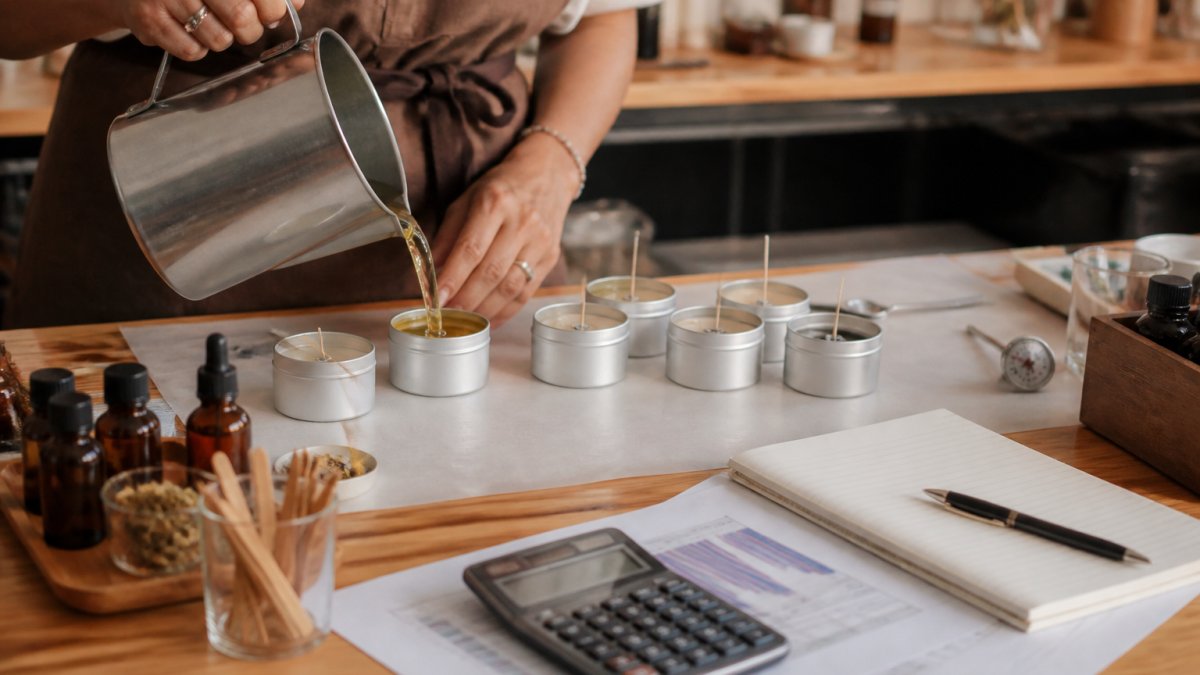
Then there's waste. Small batches mean more testing, more rejected pours, and more time spent getting a scent right before it ever reaches a customer. A factory absorbs that cost across enormous volumes. A small maker absorbs it across dozens of candles.
Forbidden Sapphire Scented Candle →
Our Forbidden Sapphire Scented Candle shows what that effort buys: a full fragrance load, decorative colour and sparkly toppings, and roughly 50 hours of burn time from an 8cm tin, all made here and suitable for vegans. That finish is done by hand, one tin at a time. You can see the range for yourself in our scented candle collection.

How Long Do Scented Candles Last, and Does Price Change That?
Most well-made scented candles last somewhere between 40 and 60 hours of burn time, and price alone doesn't guarantee that. What matters is the balance of wax, wick and fragrance, plus how you burn it. A cheap candle can claim a long burn time and still smell of nothing by hour ten; a good one keeps throwing scent to the end.
Our candles are built around roughly 50 hours of burn time, which is a useful benchmark when you're comparing. Divide the price by the burn hours and the gap between a bargain candle and an artisan one often narrows sharply. A candle that costs a few pounds and gives you a faint scent for a week is worse value than one that scents a room properly for fifty evenings.
Burn habits matter just as much. Trim the wick before each light, keep the candle away from draughts, and never burn it for more than four hours at a stretch. Those three habits will do more for longevity than any price tag.
Are Handmade Candles Worth It? A Practical Way to Decide
Handmade candles are worth it when you burn candles regularly and care about how the room smells, not just that something is flickering. If a candle is a rare decorative extra, a cheaper option will do the job. If it's part of how your home feels on a dark evening, the difference is obvious within one burn.
Here's a simple way to decide:
| If this sounds like you | Go for | Why |
|---|---|---|
| You burn a candle most evenings | Artisan | Cost per burn hour is competitive, and the scent actually fills the room |
| You want a gift that feels considered | Artisan | Hand-finished tins and proper fragrance read as a real present |
| You light a candle a few times a year | Supermarket | You won't notice the difference enough to justify the spend |
| You're scent-sensitive | Artisan | Fuller fragrance loads mean you can scent a room with a shorter burn |
| You're buying for décor only, unlit | Either | Judge on looks, not on throw |
What most guides miss is that the honest comparison is cost per hour of good scent, not cost per jar. Run that sum and the decision usually makes itself.
Conclusion
The real challenge isn't finding a cheaper candle, it's finding one that earns its place on your shelf every evening. At Absolute Whifs, we hand-pour every candle in small batches using concentrated fragrance oils, so a single tin scents a room properly for around 50 hours. Start with the Japanese Honeysuckle Scented Candle or the Wild Rose Scented Candle and see the difference a full fragrance load makes. Shop now and turn an ordinary evening into something warmer.

Frequently Asked Questions
Why are artisan candles more expensive than supermarket candles?
The gap comes down to what goes in and how it is made. Supermarket candles are usually produced in very large runs using cheaper paraffin wax and lower fragrance loads, which keeps the unit price down. Artisan candles are poured in small batches, often with soy or other plant-based waxes, higher fragrance oil percentages and hand-finished details. Those choices cost more per candle, and the maker is not buying materials at supermarket-scale volumes. You are paying for a stronger scent throw and a longer, cleaner burn rather than just a label.
How long do scented candles last, and does paying more change that?
Burn time depends mostly on wax volume and how the candle is burned, not on price alone. A well-made 8cm tin candle with a full fragrance load can give around 50 hours of burn time, as with the Forbidden Sapphire Scented Candle. Cheaper candles often burn faster because they contain less wax and more filler, and they can tunnel if the first burn is cut short. Always burn until the melted pool reaches the edge of the tin, and never move a lit candle. That single habit protects most of the burn time you paid for.
Are handmade candles worth the extra cost?
It depends on what you want from a candle. If you light one occasionally for the look, a supermarket option is fine. If you want a scent that fills a room and a burn that lasts, handmade candles usually justify the price. Look for a stated burn time, a full fragrance load and clear safety and CLP information on the listing. A candle that scents a whole living room for 50 hours works out cheaper per evening than a weak one you replace every fortnight.
What makes a candle high quality?
Four things matter most: the wax, the wick, the fragrance load and the finish. A correctly sized, self-extinguishing wick keeps the flame steady without sooting. A high fragrance load gives a strong scent throw rather than a faint one that fades after an hour. Finally, a neat hand finish and clear safety labelling show the maker has not cut corners. Ask for the burn time in hours, because that figure tells you more about value than the price tag alone.


